Saturday, May 12, 2012

Sakura Cha 桜茶

Last week I ran into some websites mentioning Sakura Cha or Cherry Blossom Tea. One of which involved cherry blossoms infused in vinegar as a health drink. The others were more palatable.
Following the directions on a Youtube site that had rather garbled English describing how to make Sakura Cha I ran out to find ... that most of the cherry blossoms had fallen from the trees and had been swept away with the rain.
Luckily I found some remaining on trees on the East side of downtown Busan (Someyeon). As you can see in the picture the blossoms are plentiful there still.
My first steeping of the tea turned out to be less than satisfactory though: Even after a 10minute steeping the tea was still insipid, though it had a finely fuzzy aftertaste a bit though.
Over the course of this month I shall dry the tea leaves and lightly roast them in the frypan as is done with green tea.

Interestingly enough the Japanese have several words for cherry blossoms depending on when they are in cherry blossom season :

first [cherry] blossoms* (hatsu hana, mid spring).

cherry [blossoms*] (sakura, late spring).

[cherry] blossoms* (hana, late spring).

late cherry [blossoms*] (osozakura, late spring).

remaining [cherry] blossoms* (zanka, late spring).

My cherry blossoms are clearly zanka which would also possibly explain why the tea is so bland...Suffice to say I shall try drying and roasting and until then, the jury is still out on this kind of tea...I'll keep you posted...

Saturday, May 5, 2012

Its been awhile since I last posted ㅜ.ㅜ I've been busy teaching and taking Chado tea ceremony classes. Here are some pictures of last years 2011 Busan Tea and Craft Fair held at BEXCO in November.


 They had vendors from all over Korea and some from China. Its nice to see Korean events slowly becoming more and more international in practice rather than in name only...
 At this particular booth a Chinese company www.taetea.com.cn did what is called these days KongFu Cha or the Chinese tea ceremony. It was in existence before the Communist revolution wiped it out, but has since resurfaced. It was brought in its past form, escaping Mao's repressions to Taiwan where it has evolved greatly. Although one can find many similarities between the Chinese and Taiwanese tea ceremonies. Some time ago my wife bought me a KongFu Tea set from China although I haven't practiced that particular ceremony in some time now... Below you can see the lady performing and serving the Korean guests.

 As you can see here KongFu tea is conducted using a Gaiwan (the bowl with lid). It is excellent for preserving the teas aroma in when steeping. It also provides space for the tea leaves to spread out, something tea balls and teabags don't do. You can find gaiwans easily in Nampodong's markets, close to Jalgachi market.


Thursday, November 17, 2011

Tea & Craft Fair @ BEXCO

Starting today, Thursday November 17th the Busan Tea and Craft Fair has started at BEXCO. I will be attending tomorrow and Saturday to get in on the good deals and make some tea contacts. There will be many booths providing tea samples so it is worth the visit !
The event is from November 17 ~ 20, 2011 from 10 a.m. ~ 6 p.m.
Tickets are 3,000 won
For more info call : 051 740-7705
or check out their website :
http://teafair.co.kr/english/
From next week I will be posting what I have learned @ the fair with regards to tea in Busan. Do drop by there and taste some of the tea that Busan and Korea have to offer !

Saturday, October 15, 2011

A Fine Bowl of the Green in Someyeon

Back in the 1200s green tea was drunken in powdered form, in bowls, wisked to a froth with a bamboo wisk. This occurred in China, Korea and Japan. At the end of the 1200s the mongols invaded, somehow wiping out this tea culture. As the mongols weren't able to successfully invade Japan, it survived there, later becoming the Japanese tea ceremony.
In Japanese and English it is called Matcha, in Korean its Malcha 말차. In Busan today, there are two places that serve green tea that way, the best of which is in Someyeon at a place called DaSoul.
SAs you can see on the map here DaSoul is located next to the McDonalds and the public library. To get there, take the street between The Burger King and the underground McDonalds heading away from the underground shopping mall street.

Heading down that street will lead you to this corner. On the left is the police station and the library. On the right, blood donation and photos. DaSoul is in that building on the 2nd floor. To the right you'll see the sign.
This is the enterance to the Zen garden that is Da Soul.
Inside you'll see there are plenty of seats. This teahouse is always busy.
As you can see here, my friend Will enjoying his tea. I quite often bring my friends here for tea as everyone always has a great time. Japanese Matcha is quite strong in flavor as you are consuming the entire leaf of the tea in your bowl opposed to infused teas. These days many Korean companies are making their own powdered green teas as the Matcha market is greatly expanding.
My main recommendation for this place is their Malcha Shake as it is called,  which is essentially a Matcha Affogato : Powdered green tea whisked to a froth with a pad of sherbert ice cream ! An awesome innovation to the Song Dynasty green tea. If you like you can simply order the Malcha and have it without the icecream the way the Goryeo dynasty Yangban used to.
Open from 12 till 12 they offer a wide variety of the traditional Korean teahouse teas but are known for their Matcha or Malcha as it is called here in Korea.

Tuesday, September 13, 2011

Osaka Matcha Tea Shop

When in Busan one "must travel to" destination is Osaka. You can take the Panstar ferry from Busan to Osaka. It takes 1 night to get there leaving Busan about 2 or 3 in the afternoon and arriving there at 10am. It is extremely convenient.
We did alot of shopping down Shinsaibashi (one main shopping street there) 2km of shopping ! One place I definitely wanted to go to was Matsuyamachi subway stop where theres an old teashop that is amazing. Expensive but worth it. They sell Japanese tea ceremony equipment. The shop is called Shibahashi. Originally I found out about this shop here which has a convenient map :
http://www.osaka-info.jp/en/search/detail/course_35.html

 The shop is on a street that runs parallel to the subway street heading east. It is mostly a residential area with not much to see on the way. 2 streets south there is a long shopping street but that's a little ways away. At the subway stop theres a few huge toy stores. Great prices too !
Shibahashi has been selling tea ceremony equipment since the 1950s.

 The sales lady was extremely helpful. I wish I had gotten her name but alas no English (My Japanese classes start in November *hmph*)  Luckily from their website I knew what I wanted, and it was on display there : One of the leather bags that contained all the things needed for a Japanese tea ceremony.
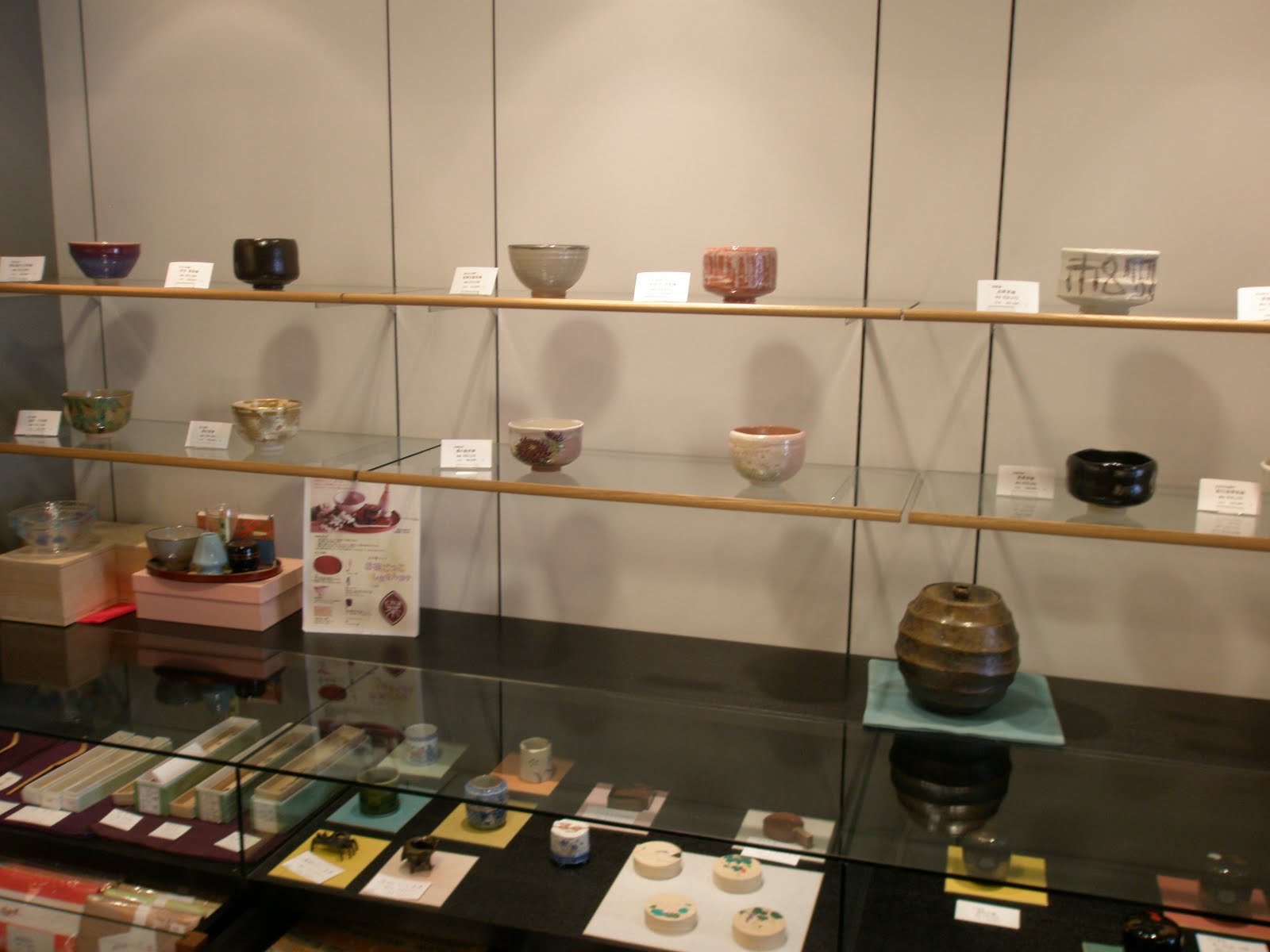
 The two teabowls on the left are originally Korean in design. Teabowls of that design are called Raku Teabowls or in Japanese and Korean: a Raku Chawan. A design that was created by a Korean potter in the 1200s. His name was Raku which is odd considering he was Korean. At that time some Koreans were brought to Japan to work for the local Samurai or for the Shogun. This is the best explanation for his Japanese name.

 The bowls on the right are also Japanese Matcha bowls. The wide rim design for those came from China during the Song Dynasty. At the very bottom is a water vessel where one would scoop out fresh water.

At the bottom, under the glass they have various 'chaire' as they are called. Chaire are containers for Matcha powder. Originally the Japanese teamasters took cosmetic containers and used them for holding their powder. These were decorated with various motifs and became part of the Japanese tea ceremony in use today.


 One of the sales staff packing my teaset and explaining how to use it. I'll do a more detailed explanation and review of the set and its use later.
 b


Friday, August 5, 2011

Japanese Tea House near Changwon

 Last year my mother in law took tea classes where she learned Japanese tea ceremony. Hearing that I was also into tea, her teacher invited us out into the countryside to visit her teahouse. It is a real Japanese teahouse; very old school. Edo period I believe, but I'm still learning. Here's what I gleaned from the ceremony so far. (It was my first Japanese tea ceremony, the only other ones I've encountered were the ones I'd seen on youtube or read about in books).

To get there we drove for about an hour and a half out of Busan last Sunday. We arrived there, just west of Changwon.
 At the foot of the hill I was given a small fan and a packet containing various cloth and paper napkins for me to bring to the ceremony.
Its nice as a guest to bring something and even nicer to be given something to bring to the ceremony.
The fan is used to mark your place. When taking tea the fan rests behind your feet. When bowing it is placed before you. During feudal Japan the samurai would leave his large sword outside the teahouse on a rack, while he would bring his smaller sword into the teahouse and place it on the tatami mat before him when bowing. Using a small fan is reminiscent of that custom.
 Before entering the teahouse, guests wash their hands and lips at the small fountain.
The teacher explained that we wash our lips to cleans away any misspoken words.

 Here's my wife beside the enterance to the teahouse. It leads to a narrow crawl space corridor.
All guests and even the host enter this way. It is a humbling crawl and a way to show that all equally enter the ceremony. It is also symbolic of going back to our birth to that place of innocence and simplicity.
 Before entering we place our fan infront of us. We bow upon entering and again upon exiting the narrow corridor/entering into the tea room.
 Here's a view of the corridor we all crawled down to get into the tearoom. At both ends there's a sliding door and even a light switch for the corridors lights.
 The teahouse consists of an enterance corridor crawl space, a main tearoom and a back room for storage and cleaning of the tea equipment.

Here is the tearoom. Zen scroll and flower water container and water kettle over a charcoal fire.
In the classes they offer here they teah you how to make tea over a charcoal fire. Very old school.

Nowadays many infuse their tea with teabags or infuse the leaves and filter out the leaves, where as originally tea was consumed by putting the ground tea leaves into water and consuming all : tea leaves and water. This was done in China Korea and Japan.
With the Mongol invasions however, this tea culture was virtually wiped out, surviving only in Japan.
The Japanese went further, developing a ceremony for tea as a means of bringing a sense of Zen unity and peace to the very warlike Samurai culture of Japan.


Upon entering the tearoom we bow to the scroll and observe the flower and the warm charcoal fire heating the water.
 Before taking the tea we eat some of the tea savories, carefully wiping the chopsticks on the napkin provided.

The tatami mats are arranged in a square pattern : one square in the middle with another mat on each side of it.
You can see in the picture the serving bowl is on one side of the line in the central square and our napkin and cooking are on the other side. Well arranged.
Once made the tea should be drunken in three sips. Getting it in a regular teahouse in Busan, (Someyeon's Green Tea House) 3 sips seems like very little tea but within the context of the ceremony, it makes alot of sense and is very satisfying.
It also ensures that the tea is very frothy. At home, when I make a small amount of tea just like they did here it turns out wonderfully. I'm still experimenting, trying to make a large amount of powdered green tea extremely frothy... I'll keep you posted.

Here just outside of Changwon, they offer 2 part classes : Japanese tea ceremony and tea history and philosophy all for 25,000 won per class (4 classes 100,000 won) classes are held on Sundays.

My wife and I are planning on going once a month, starting in September if we can find 2 other people to join us. (Carpool about 5 or 10,000 won each for gas). My wife can translate. Both the adjuma and the monk teach the classes. Contact me if you are interested.

Matthew @ 010 5737 6543


Saturday, July 30, 2011

The Rise and Fall of Green Tea in Powdered Form.

If you go far back enough in history, most of the tea was green, ground down into powder form, with small amounts tapped into a bowl and with warm water, wisked into a fine froth . Old school. This was how it was done.
Tea was served in bowls and not cups. Here in Busan it is possible to take your tea this way. Later this week I'll review the main teahouse for a bowl of powdered green located in Someyeon.
In most teastores here, powdered tea goes for about 20,000 won for a small tin. One tin will last you for a few months as you take it in small amounts. Many shops here sell the tiny scoops for the Malcha (말차) in Korean. In Japanese it is called Matcha. Many shops here also sell the bamboo wisks. I'll report on the shopping business later next month... Suffice here's the history :

Early in China's Song dynasty (960-1279) tea was taken almost like a soup with onions, pickle juice, ginger and orange peel. (Nowadays most of us foreigners have trouble with the pickles that come with our pizza !)
Later during the Song dynasty, farms began producing larger crops and farmers were able to grow a wider diversity of crops. Thus, tea became more widely grown making it less of a luxury and suddenly a drink even the poorest could afford. Teahouses flourished with many serving soups as well as tea savories.
As they are in China today these teahouses became centers for business meetings. Although during the Song dynasty they more closely resembeled the British coffeehouses of the 1800s : providing not only the latest news (no Internet then), but also entertainment. (Many British coffeehouses employed entertainers to read the news and provide humor as well as song).
It was during this time the green tea leaves were ground down into a powder form and whipped in hot water with a bamboo wisk. Tea was also taken in shallow saucers (called chen) as well as bowls while the tea in soup form understandably disappeared. Later, with the Mongolian invasions this tea culture changed greatly in China becoming what we now see mostly thoughout the anglosphere : tea infused in water with the leaves discarded.
Which brings one important point : with green tea in powder form : nothing is wasted and one gets the maximum health benefits of green tea when you take it in powdered form.

During the height and the waning of the Song dynasty in China, in Korea, green tea was also drunken in powdered form during the Goryeo period (981-1392). This method of taking green tea came from China which is one reason a small group of Koreans nowadays feel free to promote the Japanese Zen tea ceremony here in Korea, for even Zen Buddhism came from China originally.

It was during China's Song dynasty that a Japanese monk named Eisai travelled to China upon relations improving between these two countries. (Earlier Japanese pirates would raid Chinese ships while at the same time Japanese traders were trying to trade with China for, among other things, Chinese silks for their kimonos). China got fed up with it all and closed itself off entirely from Japan. This, is only part of that story, but I wish not to digress.
In 1191, Eisai came back to Japan with tea seeds and the teachings of the Rinzai sect of Zen Buddhism. He also brought with him the method of taking the tea in powdered form. Zen Buddhism stressed the value of developing a skill with the aim of the highest form of technique through self discipline it also taught a sense of defiance in the face of death that matched well with the Samurai code. Indeed, later in the 1300s many Samurai would regularily conduct tea ceremonies as well as collect tea implements for their beauty.

The Japanese tea ceremony first, developed out of the practical preparation of tea shortly after 1191. In the 1300s things became more artistic and focussed on the beauty or art around the ceremony.
Later the ceremony became more finely tuned when the ideals of Buddhism and Taoism came into influence.
These new ideals were greatly promoted by the monk Murata Shuko (1521-1591). He wrote of the value of unadorned objects, the cracked and imperfect as being a reflection of the beauty found in nature. It is this appreciation we find in the Japanese tea ceremony as practiced today. It was Shuko who asked by the shogun Yoshimasa to create a tea ceremony for him. Making Shuko the first tea master and official founder of the Japanese tea ceremony.

From the 1500s to the 1800s Japanese tea ceremony flourished. However, in the early 1900s Japan began a period of rapid modernization. Railroads were built across the country, shogunates became the present day prefectures as the Japanese military was modernized. It was during this time that scholar and samurai decendant Kakuzo Okakura came to New York and wrote his "The Book of Tea". Fluent in both Chinese and English, Okakura became disturbed by not the modernization of Japan but the utter disregard his fellow Japanese were showing as they carelessly discarded their own cultural heritage in adopting western ways. Okakura was greatly influential in the American art world, persuading many gallery owners and universities to begin collecting ancient Japanese art works. He served many as a consultant and art critic thus preserving many Japanese art works from destruction at the hands of his fellow countrymen. It is his work, "The Book of Tea" that is widely read today as a celebration of the ideals of tea ceremony and Zen philosophy. His work was written in English for foreign eyes to see the inherent values in ancient Asian ways and to appreciate nature, art and tea. It is available here in Korea from http://www.whatthebook.com/ :) It is due to the works of men and women like Okakura that the art of tea is preserved todays modern times.