Saturday, June 16, 2012

Busan Tea and Craft Fair

Drop by while you can! The Bi-annual Busan Tea & Craft Fair is on at BEXCO. Interestingly enough it coincides with the Cafe Fair also going on at BEXCO. However, unless you are going to join a coffee franchise I suggest you drop by the Tea & Craft fair: Theres lots of stuff you can buy for your home or as gifts !


As you can see here there are alot of Korean tea sets for sale and at decent prices too !This year there are at least 3 vendors from China mostly selling Pu'er tea.
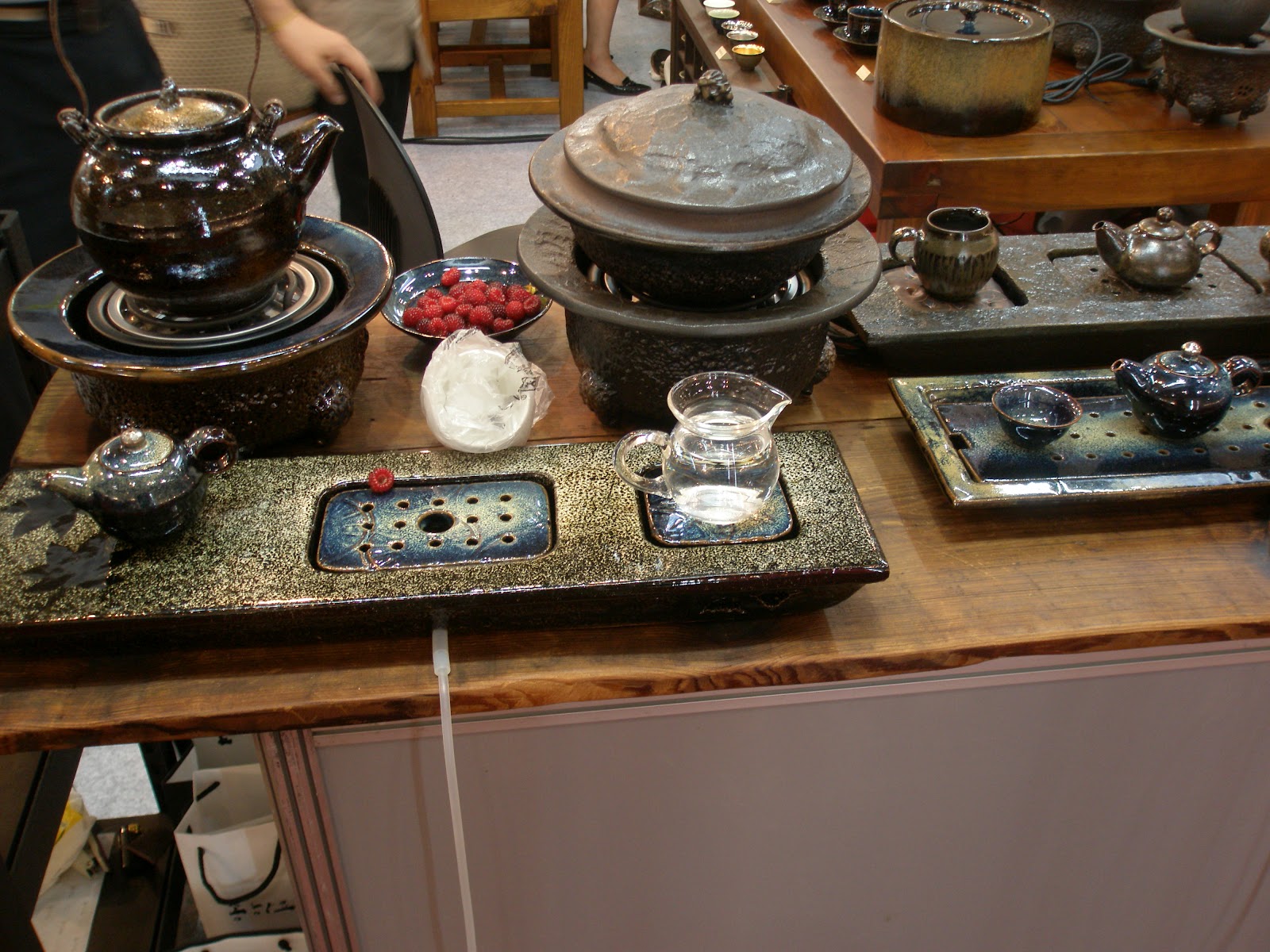

Mother of Pearl !


 Portable tea sets are also available for about 100,000 won (100USD) to 200,000 won.
There are also more potters this time as well ! Every 6 months it gets better and better. So drop by BEXCO the fair is open only until tomorrow !

Friday, May 18, 2012

Praises of the Korean Teapot: An ideal gift idea!

These days in the west restaurants, tea shop owners and conoisseurs are all singing the praises of loose leaf tea. There has been a mass proliferation of teashops in Canada and the U.S. selling loose leaf tea. Yet the West is lacking hte hardware required to get the most out of this 'loose leaf' tea that is so widely promoted and praised. The concept is simple: With loose leaf tea, in principle, the tea leaves are free to swish around and blossom open in the water releasing their fragrance more and providing consumers with a better cup of tea.
The problem the West is having (that has been solved here in Asia for centuries) is with hardware. Most western tepots have one hole for the spout and must use a wire mesh insert inside to hold the leaves. The problem with this is that the leaves haven't the full pot to roam around in. A more horrible solution is the tea infuser pictured at right:

Loose leaf tea, yet confined in a small ball like infuser. You might as well be using a teabag then ! Here in Korea we use teapots that don't require an infuser ~or~ a wire mesh insert ! Its what's inside that counts !
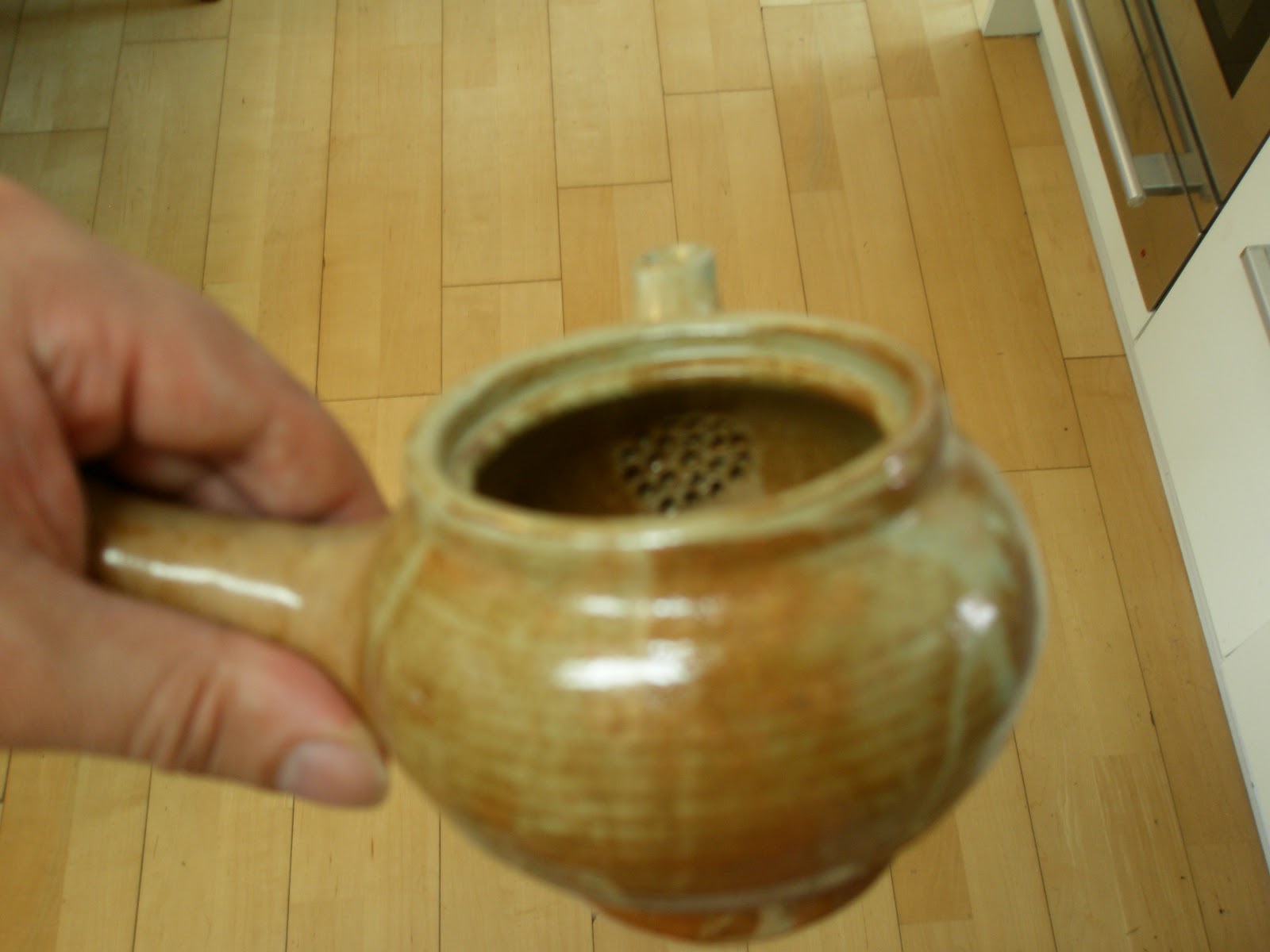
Here are two of my 3 Korean teapots I have at home. The one on the left was a gift. The larger one on the right is one I made myself.

 As you can see inside the solution is mindblowingly simple: instead of one hole there are tonnes of tiny ones forming a filter for the leaves ! This way the leaves are free to roam around the entire pot. With all the loose leaf tea shops opening up across Europe and North America the Korean teapot is an excellent gift to send your folks overseas while you are here in Asia!
Here in Busan Nampodong and Pyunghwa Markets have plenty of Korean tea sets. In Nampo market the Korean teasets @ Tamina go for about 20,000 - 40,000 won each.
Now I'm just wondering when the potters in the west will pick up on this idea...

Saturday, May 12, 2012

Sencha 煎茶 and Sumo 相撲

All this week Sumo wrestling is on TV via Japan's NHK broadcasting channel!                   To celebrate I pulled out my Chinese Gong-Fu teaset and brewed up some Japanese sencha green tea (煎茶) I picked up in Osaka to go with of all things nachos and salsa. I chose the sencha as it is Japanese matching the sumo. The gaiwan, as it was how we took the tea at an old teaseller's shop in Osaka. The lid of the gaiwan preserves the scent of the tea quite well.
The natcho chips and salsa are of course a western sports tradition...

 In breaks in the action I've been reading book 2 in the Tea Shop Mysteries series by Laura Childs.
Set in Charleston U.S.A the book is steeped in American teahouse culture providing, in the midst of the mystery plenty of information on different teas as well as the pastries served with them as part of the British/Western tea culture.
Ever since "Death by Darjeeling" I've been hooked on the series. Her website provides her stories in chronological order along with a synopsis for each : Tea Shop Mysteries.

I most highly recommend her stories for those getting into western tea culture or those looking to expand their western tea service.
 Here's a picture of my gaiwan. I'll provide instruction on using a gaiwan in a future post. Once I get better and more familiar with the Gong-Fu tea ceremony.

Sakura Cha 桜茶

Last week I ran into some websites mentioning Sakura Cha or Cherry Blossom Tea. One of which involved cherry blossoms infused in vinegar as a health drink. The others were more palatable.
Following the directions on a Youtube site that had rather garbled English describing how to make Sakura Cha I ran out to find ... that most of the cherry blossoms had fallen from the trees and had been swept away with the rain.
Luckily I found some remaining on trees on the East side of downtown Busan (Someyeon). As you can see in the picture the blossoms are plentiful there still.
My first steeping of the tea turned out to be less than satisfactory though: Even after a 10minute steeping the tea was still insipid, though it had a finely fuzzy aftertaste a bit though.
Over the course of this month I shall dry the tea leaves and lightly roast them in the frypan as is done with green tea.

Interestingly enough the Japanese have several words for cherry blossoms depending on when they are in cherry blossom season :

first [cherry] blossoms* (hatsu hana, mid spring).

cherry [blossoms*] (sakura, late spring).

[cherry] blossoms* (hana, late spring).

late cherry [blossoms*] (osozakura, late spring).

remaining [cherry] blossoms* (zanka, late spring).

My cherry blossoms are clearly zanka which would also possibly explain why the tea is so bland...Suffice to say I shall try drying and roasting and until then, the jury is still out on this kind of tea...I'll keep you posted...

Saturday, May 5, 2012

Its been awhile since I last posted ㅜ.ㅜ I've been busy teaching and taking Chado tea ceremony classes. Here are some pictures of last years 2011 Busan Tea and Craft Fair held at BEXCO in November.


 They had vendors from all over Korea and some from China. Its nice to see Korean events slowly becoming more and more international in practice rather than in name only...
 At this particular booth a Chinese company www.taetea.com.cn did what is called these days KongFu Cha or the Chinese tea ceremony. It was in existence before the Communist revolution wiped it out, but has since resurfaced. It was brought in its past form, escaping Mao's repressions to Taiwan where it has evolved greatly. Although one can find many similarities between the Chinese and Taiwanese tea ceremonies. Some time ago my wife bought me a KongFu Tea set from China although I haven't practiced that particular ceremony in some time now... Below you can see the lady performing and serving the Korean guests.

 As you can see here KongFu tea is conducted using a Gaiwan (the bowl with lid). It is excellent for preserving the teas aroma in when steeping. It also provides space for the tea leaves to spread out, something tea balls and teabags don't do. You can find gaiwans easily in Nampodong's markets, close to Jalgachi market.


Thursday, November 17, 2011

Tea & Craft Fair @ BEXCO

Starting today, Thursday November 17th the Busan Tea and Craft Fair has started at BEXCO. I will be attending tomorrow and Saturday to get in on the good deals and make some tea contacts. There will be many booths providing tea samples so it is worth the visit !
The event is from November 17 ~ 20, 2011 from 10 a.m. ~ 6 p.m.
Tickets are 3,000 won
For more info call : 051 740-7705
or check out their website :
http://teafair.co.kr/english/
From next week I will be posting what I have learned @ the fair with regards to tea in Busan. Do drop by there and taste some of the tea that Busan and Korea have to offer !

Saturday, October 15, 2011

A Fine Bowl of the Green in Someyeon

Back in the 1200s green tea was drunken in powdered form, in bowls, wisked to a froth with a bamboo wisk. This occurred in China, Korea and Japan. At the end of the 1200s the mongols invaded, somehow wiping out this tea culture. As the mongols weren't able to successfully invade Japan, it survived there, later becoming the Japanese tea ceremony.
In Japanese and English it is called Matcha, in Korean its Malcha 말차. In Busan today, there are two places that serve green tea that way, the best of which is in Someyeon at a place called DaSoul.
SAs you can see on the map here DaSoul is located next to the McDonalds and the public library. To get there, take the street between The Burger King and the underground McDonalds heading away from the underground shopping mall street.

Heading down that street will lead you to this corner. On the left is the police station and the library. On the right, blood donation and photos. DaSoul is in that building on the 2nd floor. To the right you'll see the sign.
This is the enterance to the Zen garden that is Da Soul.
Inside you'll see there are plenty of seats. This teahouse is always busy.
As you can see here, my friend Will enjoying his tea. I quite often bring my friends here for tea as everyone always has a great time. Japanese Matcha is quite strong in flavor as you are consuming the entire leaf of the tea in your bowl opposed to infused teas. These days many Korean companies are making their own powdered green teas as the Matcha market is greatly expanding.
My main recommendation for this place is their Malcha Shake as it is called,  which is essentially a Matcha Affogato : Powdered green tea whisked to a froth with a pad of sherbert ice cream ! An awesome innovation to the Song Dynasty green tea. If you like you can simply order the Malcha and have it without the icecream the way the Goryeo dynasty Yangban used to.
Open from 12 till 12 they offer a wide variety of the traditional Korean teahouse teas but are known for their Matcha or Malcha as it is called here in Korea.